Huawei Mate 20 X 5G Teardown
ID: 124808
Description: While the US-China trade dispute drags on and...
Steps:
- Here's the lowdown on this Mate 20 X 5G:
- 7.2" OLED multitouch display with 1080 × 2244 resolution
- Octa-core Huawei Kirin 980 chipset, paired with 8 GB RAM
- 256 GB onboard storage
- Balong 5000 multi-mode 5G modem
- 4,200 mAh battery with 40 W SuperCharge 2.0 support
- Triple rear cameras: 40 MP ƒ/1.8, 20 MP ƒ/2.2, and 8 MP ƒ/2.4 lens with 5x optical zoom
- The front-facing camera resides in a "waterdrop" notch, and the rear protective cover comes with a neat reminder which we will dutifully ignore.
- On the bottom we recognize the usual suspects: a USB-C port, two microphone holes and a speaker grille.
- Along the top edge, we find another microphone hole, the infrared blaster, and the barest sliver of a grille for the earpiece speaker.
- Compared to the already-large Mate 20 Pro, the X 5G looks colossal. On its backside, we note the 5G branding, and the fingerprint sensor underneath its array of cameras.
- Though this Mate is only rated IP53, the SIM card tray is equipped with a rubber gasket—something we usually see on "waterproof" smartphones these days.
- Slot 1 of this SIM tray is reserved for 5G cards, whereas slot 2 only accepts up to 4G cards.
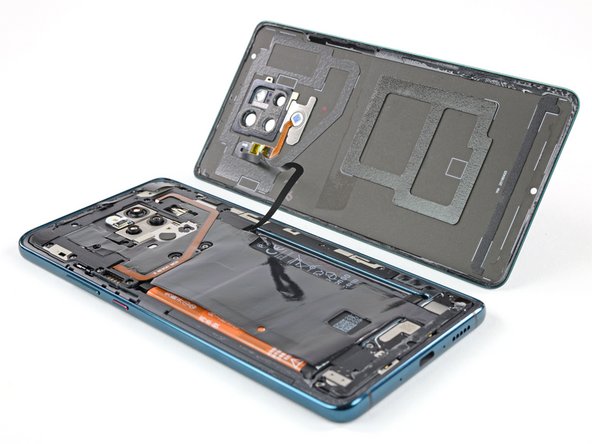
- To our surprise, we get the glued-down back cover off lickety-split—no heat required! A suction handle and a halberd spudger separates everything nicely.
- Adhesives can harden with age, so maybe next time won't be so easy—but our fresh-from-the-factory unit was very cooperative.
- A generously proportioned fingerprint flex cable keeps the back cover tethered for now, but it's such a long leash that we don't mind. On to the next layer.
- A flock of screws hold the NFC coil, antenna, and graphite heat conductor pad in place. One hides behind a tamper-proof sticker, and another one lurks under the camera flash module—a strange place for a screw.
- With those bits out of the way, we can finally disconnect the fingerprint sensor and get our first good look inside this phone.
- The 24 MP, ƒ/2.0 front-facing peeper comes out with a simple pry. We'll never grow tired of these repair-friendly press-fit connectors.
- The motherboard also comes out easily, allowing us to unplug the three-eyed rear camera block from the back.
- This triclops carries the same tech as the Mate 20 Pro from October 2018—a 40 MP ƒ/1.8 wide angle, a 20 MP ƒ/2.2 ultra wide angle, and an 8 MP ƒ/2.4 telephoto lens.
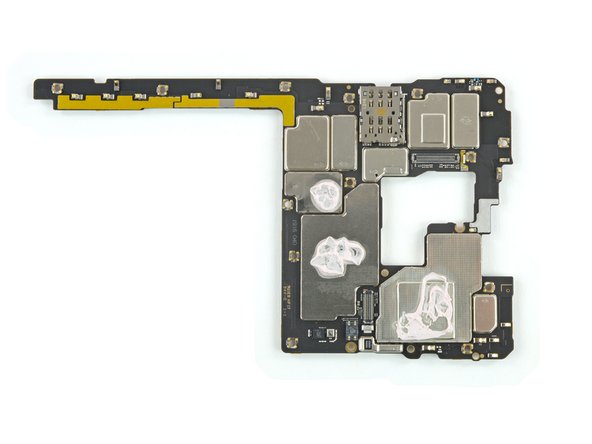
- Finally, we get to the nitty-gritty of this Mate's iteration—the motherboard:
- Micron D9WGR (MT53D1G64D8NZ-046 WT:E) 8 GB LPDDR4 with Kirin 980 SoC layered underneath
- Toshiba THGAF8T1T83BAIR 256 GB NAND flash
- Samsung K4UHE3D4AA-CGCJ 3 GB LPDDR4X—more on that later
- Skyworks 78191-11 low-band front-end module for WCDMA/LTE
- HiSilicon Hi6526 PMU
- NXP 80T37 (likely NFC controller)
- For comparison, the smaller board on the lower left belongs to the Mate 20 Pro.
- … more on the other side of the board:
- Qorvo 77031 4T8R mid/high-band module
- HiSilicon Hi63650
- HiSilicon Hi6421 power management IC
- HiSilicon Hi1103 Wi-Fi module
- HiSilicon Hi6D03
- And again the smaller Mate 20 Pro motherboard for comparison.
- Notably absent from our initial chip findings is the Balong 5000, HiSilicon's multi-mode networking chipset that is supposed to be the powerhouse of this 5G cell.
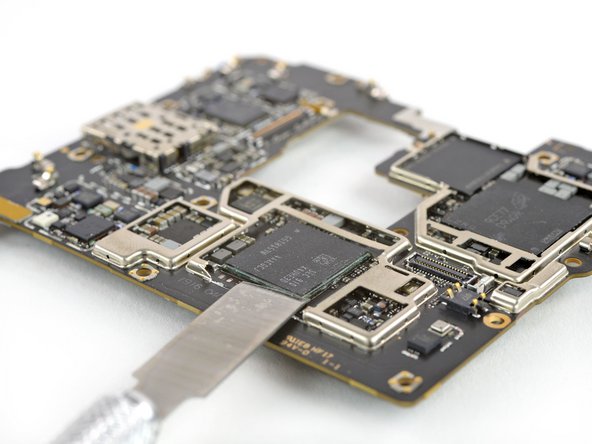
- On a hunch, we coarsely chisel off the extra Samsung LPDDR4X chip to find …
- HiSilicon Hi9500 GFCV101! This is most likely the Balong 5000 we're looking for.
- Just to be sure, we pry up the Micron memory chip as well. Sure enough, underneath slumbers the HiSilicon Hi3680 GFCV150, also known as Kirin 980.
- Our hot air station had the day off. Deal with it.
- It looks like the 5G modem comes bundled with its own block of dedicated LPDDR4X memory—a whopping 3 GB of it, if we've decoded those Samsung package markings correctly. Is that a giant data buffer? This is the first 5G modem we've seen in the wild, so sound off in the comments if you know more than we do.
- To get unobstructed access to the battery, we remove the board interconnect cable.
- While we're at it, we also pry up the glued-in loudspeaker ...
- … and the tiny daughterboard with the USB-C port soldered onto it.
- We're always happy to see built-in battery removal instructions, and follow them step-by-step. It's as easy as 1-2-3!
- Though we didn't need heat this time around, we are still rewarded with a clean battery extraction.
- This is the exact same battery used in the Mate 20 Pro, weighing in at 16.04 Wh (4,200 mAh @ 3.82 V).
- That's well short of the whopping 19.1 Wh (5,000 mAh) battery in the standard Mate 20 X—but it's still a monster compared to the iPhone XS Max's dual-cell, 12.08 Wh (3,179 mAh) powerplant.
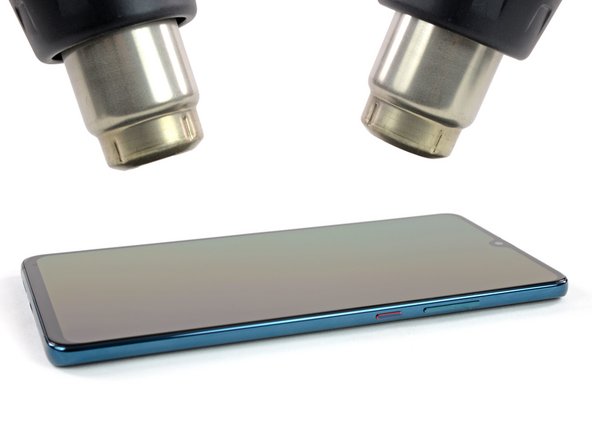
- The display adhesive holds on a bit tighter than the back cover adhesive, but gives way after some heat and skilled halberd slicing.
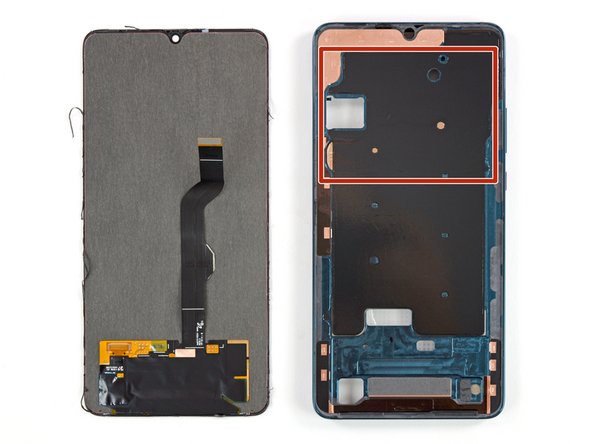
- This Mate doesn't have any fancy under-display fingerprint sensor. There's just a blank OLED screen and the aluminum frame.
- This 7.2 inch OLED panel is manufactured by Samsung.
- Much like in the standard Mate 20 X, there's a big vapor chamber hiding on the aluminum frame behind the graphite foil.
- With all the parts more or less gently removed, we have an overview of Huawei’s foray into the mobile 5G sector.
- Except for three "US"-manufactured chips (Micron, Skyworks and Qorvo) and a dutch NXP module, the motherboard's major sockets are dominated by Huawei's in-house brand HiSilicon and other Asian manufacturers (Toshiba, Samsung).
- Want to see future smartphone guts from Huawei? Subscribe to our newsletter and stay in the loop.
- The Huawei Mate 20 X 5G earns a 4 out of 10 on our repairability scale (10 is the easiest to repair):
- Many components are modular and can be replaced independently.
- The battery is accessible after removing the rear cover and midframe, and is equipped with pull tabs.
- Standard Phillips screws are used along with an average amount of adhesive.
- The midframe covers the battery and fingerprint sensor connectors, and is itself obstructed by the camera sensors and flash.
- Glued-down front and back glass means greater risk of breakage, while making all repairs difficult to start.
- Screen repairs will require near-complete disassembly.