MacBook Air 13" Early 2020 Fan Replacement
ID: 142675
Description: Use this guide to replace the fan in an Early...
Steps:
- Before starting this procedure, you should disable your Mac's Auto Boot feature. Auto Boot powers on your Mac when you open the lid, and may be accidentally triggered during disassembly. Use this guide to disable Auto Boot.
- If your MacBook is running Big Sur v11.1 or later, disabling Auto Boot may not work. You can proceed normally, but make sure to disconnect the battery as soon as you're inside.
- Completely power off and unplug your MacBook Air before you start. Close the display and flip the entire laptop upside-down.
- Use a P5 driver to remove the following screws:
- Two 7.9 mm screws
- Two 7.1 mm screws
- Six 2.6 mm screws
- Throughout this repair, keep track of each screw and make sure it goes back exactly where it came from to avoid damaging your MacBook.
- Wedge your fingers between the display and the lower case and pull upward to pop the lower case off the Air.
- Remove the lower case.
- To reinstall the lower case:
- Set it in place and press firmly to engage the two hidden clips underneath. You should feel and hear them snap into place.
- Peel back the tape covering the battery connector enough to reveal the connector underneath.
- Use a spudger to slide the battery connector parallel to the logic board and out of its socket on the logic board.
- Slide the pointed end of a spudger underneath the speaker cable and pry straight up to disconnect it.
- Use a T4 Torx driver to remove the three 1.4 mm screws securing the audio board connector cover.
- Remove the audio board connector cover.
- Use the flat end of a spudger to pry the audio board connector straight up to disconnect it from the board.
- To re-attach press connectors like this one, carefully align and press down on one side until it clicks into place, then repeat on the other side. Do not press down on the middle. If the connector is misaligned, the pins can bend, causing permanent damage.
- Use the flat end of a spudger to pry the Touch ID cable straight up to disconnect it from the audio board.
- Continue to slide the spudger underneath the Touch ID cable to release it from the audio board.
- The Touch ID cable is secured to the audio board with some light adhesive.
- Remove the three screws securing the audio board:
- Two 4.3 mm T4 Torx screws
- One 2.4 mm T3 Torx screw
- Remove the audio board.
- Use a pair of tweezers to peel back the black tape covering the fan cable connector.
- Use the pointed end of a spudger to lift up the small locking flap on the fan cable's ZIF connector.
- Slide the fan cable out of its connector.
- If possible, grip the cable by the tape, not by the cable itself.
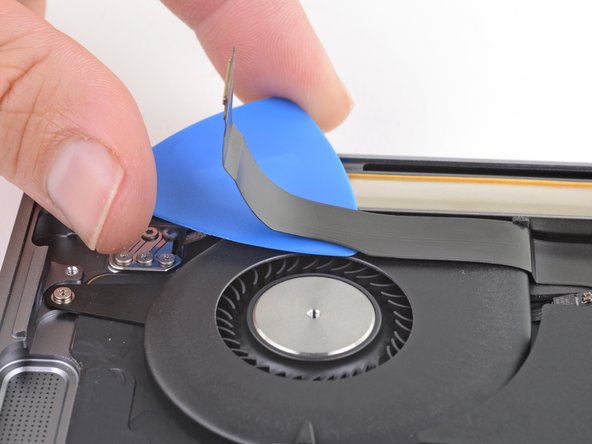
- Slide an opening pick underneath the audio board cable to separate it from the fan.
- The cable is secured with some light adhesive.
- If the adhesive is stubborn, do not force the pick. Lightly heat the cable using an iOpener or a hair dryer to soften the adhesive.
- Use a T4 Torx driver to remove the three 2.7 mm screws securing the fan.
- Lift the fan out of the case to remove it.