Nespresso Delonghi 165 Coffee Machine leaks water and coffee into capsule compartment: unclogging Coffee Spout.
ID: 167742
Description:
Steps:
- Water leaking into the capsule compartment, a problem seen in multiple Nespresso coffee machines, across different models, is a result of COFFEE RESIDUE CLOGGING THE OUTLET OF THE COFFEE SPOUT where coffee is dispensed.
- Some machines can easily be taken apart and the spout can be cleaned from the inside, perfect example: here, but in this case, it is not that simple.
- In other models cleaning is not as easy. Since it requires disassembling the entire machine; and they do not use screws (like this model EN165), they use a latching system of "Tabs or pins" there is risk of breakage... which precludes reassembly.
- In these photos you see the machine with the left cover removed, but worry not; you don't need to do this to unclog the machine. This side part was dismantled so I could repair a bad contact on the left button—you had to press it quite hard to get it to work.
- To check whether the coffee dispensing spout, is semi-clogged, we must remove the capsules inner compartment, to look inside.
- We leave only the bottom water collection tray, and make a cup of coffee, to observe what is comes out. If the coffee flows into the cup and SIMULTANEOUSLY PART OF THE WATER leaks into the inner compartment, one of the four outlet holes is certainly blocked.
- If this happens we certainly can assume, that 1 or 2 are clogged, blocking the coffee's exit, and instead to leak to the inside, into the capsule compartment.
- Note: In the photo, we see the coffee is clear, because I've already used the capsules for other tests.
- How can we unclog the spout WITHOUT DISASSEMBLING THE MACHINE?
- There are several ways; here, I will explain three.
- We unplug the machine from any electrical outlet.
- We remove the water tank.
- We will lay the machine down (on it's side).
- Using a bright LED flashlight, we do an initial inspection. Sometimes a mirror is helpful.
- As we can see in the photos, at the bottom of the 'parrot's beak', in the (+) we see that in each opening there is a round orifice, THOSE ARE THE EXIT HOLES OF THE COFFEE.
- If you look closely, in this case, you will see on the bottom right, it is clogged, it's hard to see, but its thick.
- Here is a better view.
- Do you see that, yes, you can see the two round holes at the top and on the left?
- First Method for unclogging WITHOUT DISASSEMBLING THE MACHINE.
- Using a RIGID 1.5 mm or 2.5 mm electrical wire, we strip about 2 cm of insulation from the end, then feed it through the stuck hole, about 1.5 cm so that the wire enters and can be turned inside the cavity.
- If you can't feed in the 2.5 m wire, start with the 1.5 mm wire.
- We will repeatedly insert, remove, and insert, turning and extracting, in all four holes, not just the one with the problem.
- If you can't get your hands on rigid copper wire, a non-copper wire might also work, or multi-stranded, braided copper wire, but they are harder to get in.
- ATTENTION: DO NOT INSERT WOODEN IMPLEMENTS, IF THEY BREAK, WHICH IS VERY LIKELY, YOU WILL NOT BE ABLE TO REMOVE THEM.
- Another option you could use is a flexible wire of 1.5mm or 2mm but it will not be as easy as the rigid cable, and it will be difficult to insert.
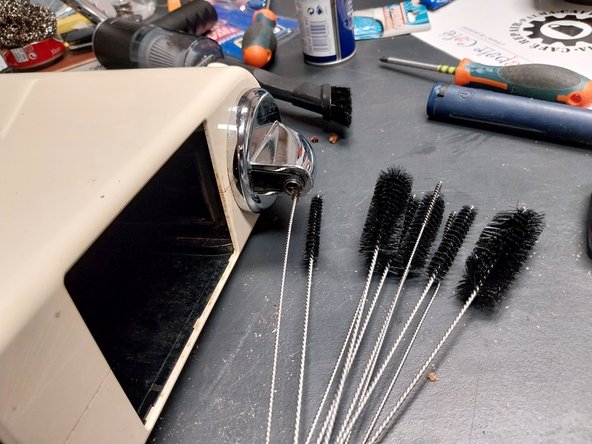
- Second Cleaning Method, Cleaning Brush. Get the two thinnest sizes. You repeatedly insert, rotate and remove. This is a useful method, but since the holes are very small, they are difficult to insert.
- You could buy these types of brushes online, for example on Aliexpress.
- Second B or ALTERNATE BRUSH OPTION - A type of brush that's easy to find are toothbrushes. Sold in supermarkets and pharmacies; the bristles are thinner, but they can also be useful.
- The 3rd cleaning method, however, realistically it is a continuation or part two of the other two methods.
- Syringes of 5mm or more with a large bore tube (like the ones that are used to replace ink cartridges, must be 2mm or smaller.)
- Fill the Syringe with water, insert it into the four holes and inject the water.
- If we want to be more effective, instead of using water we could instead use vinegar,(it will be better at dissolving the coffee grounds). NOTE: Warm the vinegar or water-vinegar solution, to improve it's efficacy farther. Do Not make it hot enough to burn yourself !
- Or you can mix them both 50% water and vinegar.
- I RECOMMEND DOING ALL THREE CLEANING METHODS , ONE AFTER THE OTHER AS SHOWN IN THE PICTURES, TO MAKE SURE THAT IT IS COMPLETELY CLEAN.
- I couldn't take photos of this step; to finish cleaning the holes turn the machine upside down, incline it ≈30 to 40 º under the tap, so that the water enters the parrot's beak and comes out partly through the capsule press filter. When I can I will take photos of this step. If you are uncertain, don't do it. The others methods are sufficient.
- A complement to the cleaning that would already be finished, is the cleaning for the capsule press sieve, which can be done with a toothbrush and vinegar (wine). Here is a video I made a few years ago.
- Video
- Other options that can be used to unclog when there is no rigid copper wire available are:
- Tiny nails, for example, the remaining ones that are left from a furniture piece from IKEA. They work really well because they have grooves or curves on them.
- Watchmakers screwdrivers, but be careful only the two smallest sizes will work for us, we should not insert them with force.
- Wires up to 2mm.
- Finally, we will be making several coffees WITHOUT CAPUSLES, so that the the exit is completely clean.
- I recommend filling up the water tank, and making an entire tanks worth of cofees until you see the water is being dispensed into the cup is clean and has no coffee grounds or residue.
- We will be running the coffee machine until the water comes out clear. If everything went well, we will see that, the water is not leaking into the compartment, if a single drop, that's Okay but NOT a steady trickle like before our cleaning.
- As you can see, the compartment is dry. This repair was done at Repair Cafe Palma, during one of the sessions, so I'm sorry the pictures are not in better resolution or detail.
- The manual for this machine can be found on google, in case it helps anyone: manual
- This guide should work on similar old Nespresso machines, however some may not actually have holes and, curiously; THE NEWER MACHINES FROM APPROXIMATELY 2021, EVEN WHEN WORKING CORRECTLY AND BEING NEWER, LOSE MORE WATER THAN THE OLDER MODELS.