PRYLUX BRENO LED spotlight fault: how to diagnose where the fault is?
ID: 236336
Description:
Steps:
- Example of a PRYLUX recessed spotlight; let's take a look at it to determine where the fault lies, whether in the LED driver or in the spotlight.
- LED board bulb features
- The driver is very basic; one of the details showing that the driver is basic is firstly that its specifications DO NOT indicate the maximum voltage it can output, as we can see in the photos of the housing in step 1.
- Secondly, we can see that it is a basic driver due to the small number of components, its use of only one electrolytic capacitor, and because it does not have a fuse-function resistance on the component side; it has it on the copper trace side.
- Tested the electrolytic capacitor; the 47 uF one measures 60 uF, which is a very typical symptom of faulty capacitors, as they can measure either half of their capacity or a much higher capacity than indicated on their markings.
- Connection under test.
- Checking the input resistance state, fuse function is OK. 15 Ohms.
- With the circuit powered on, the voltage is spiked at no-load, ranging from 199 to 200 V, a typical symptom of an unregulated circuit. This high voltage, when the LEDs burn out, damages the 47 uF / 160 V capacitor because it exceeds the capacitor's working voltage.
- As we can see, the capacitor is clearly damaged; it is bulging, it tests poorly, and there is material from the inside expanded onto one of its pins, so the capacitor is clearly faulty.
- Let's look at the LED spotlight now; the heat has damaged the white plastic diffuser.
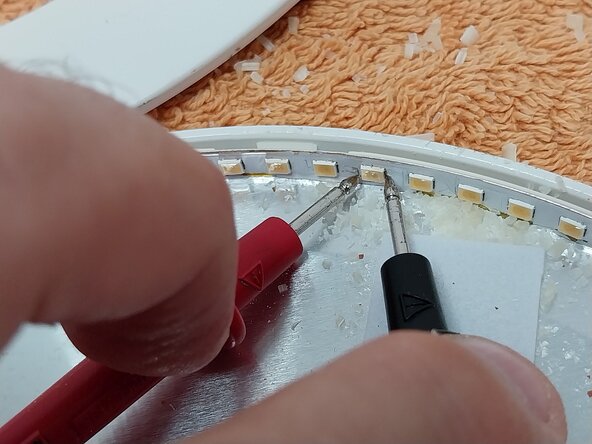
- Checking the LED strips, they do not energize with the multimeter on the ohms scale, as the LEDs have a higher voltage, but we see several LEDs clearly with a black center dot, as if they are burned out.
- The capacitor of 47 uF / 160 V on the driver can be replaced, but the LED bulb has no solution because it has several burned-out LEDs and, as it is a plastic-type strip with copper tracks, it is not feasible to replace the LEDs.